
Fair Go Casino Complaints and Player Feedback
 Available in AU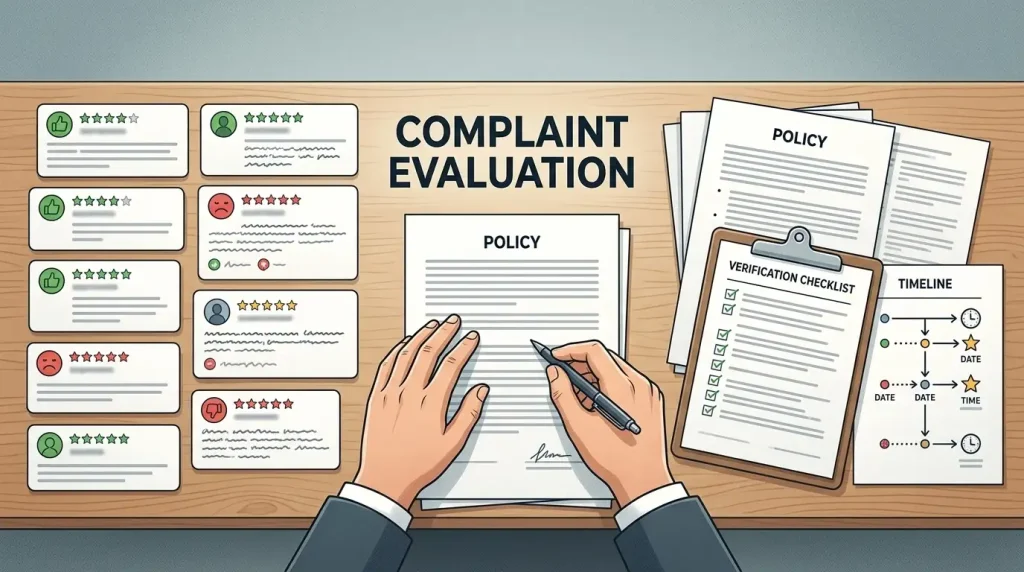
Current public review pages contain both positive and negative Fair Go Casino reports. Recurring themes include account verification, withdrawal timing, support interactions and bonus conditions. Those reviews are useful as signals, but they are anecdotes rather than audited records of what happens to every account. A complaint can identify a question worth checking, while the casino’s current banking, verification and terms pages are better sources for rules that can be verified directly. This analysis therefore groups recurring feedback themes, compares them with official policies where possible, and avoids turning star ratings or individual accusations into a factual assessment about misconduct.
Table of Contents
- What the current review corpus shows
- Theme 1: verification can become the main withdrawal friction point
- Theme 2: withdrawal timing reports vary
- Theme 3: support reviews are inconsistent
- Theme 4: bonus conditions generate some of the sharpest complaints
- Why one dramatic review is not proof of fraud
- Complaint databases provide more structure, but still need context
- How official rules compare with recurring complaints
- What evidence strengthens a complaint
- Australian regulatory context matters for escalation
- A practical way to read Fair Go reviews
- Using complaint evidence carefully
- Fair Go complaints FAQ
What the current review corpus shows
Fair Go’s public feedback is mixed rather than uniformly positive or negative. Trustpilot currently displays recent favourable comments about gameplay, customer service and receiving funds, alongside negative reports about withdrawal requirements and repeated requests during the payout process. Casino Guru’s current Fair Go page also contains both positive and negative user experiences and a complaint database that includes delayed-payment, verification, account and bonus disputes.
The important point is not the platform’s overall rating or safety score. Those are platform-specific summaries with their own methodologies. For this section, the useful information is the recurrence of particular subjects across individual reports: verification before withdrawal, the time between a withdrawal request and receipt of funds, communication with support, and how bonus rules affect cash-out eligibility.
Theme 1: verification can become the main withdrawal friction point
Several negative reviews describe verification as slow, repetitive or difficult, while some positive reviews describe it as straightforward. That difference is plausible because Fair Go’s current official verification process is account-specific. The casino says winnings cannot be processed before the account is verified and lists government-issued photo ID and proof of address as core documentation. It also reserves the right to request extra evidence connected with cards or eWallets.
This official rule explains why verification appears so often in withdrawal discussions without proving that any particular complaint is justified. A user who is asked for a new document may experience the process as an unexpected delay. The casino may regard the request as required account verification. To decide what happened in one case, a reviewer would need the exact document request, submission timestamps, rejection reasons and subsequent casino responses.
The dedicated Fair Go verification guide covers the current document list and separates verified requirements from timing claims that are not published as a universal guarantee.
Theme 2: withdrawal timing reports vary
Public reviews include both reports of relatively prompt withdrawals and complaints about delays. Fair Go’s current banking page says it aims to process withdrawals within up to two business days, and its FAQ says payouts are processed within two business days from submission once the required verification process is complete. That is a casino processing target, not a guarantee that money reaches a bank account or wallet within the same period.
A player’s total wait can include more than one stage: verification, casino review, payment release, and the receiving bank, wallet or payment network. Reviews often compress those stages into one statement such as “my withdrawal took a week” or “I was paid in two days”. Without timestamps for each stage, those statements cannot be compared cleanly with the casino’s published processing window.
For the current rules and weekly limit, see the Fair Go Withdrawals: Methods, Limits and Timing. It is more useful for factual payout mechanics than an anecdotal average made from a small review sample.
Theme 3: support reviews are inconsistent
Fair Go currently advertises 24/7 live chat, and the currently available information verifies that channel. Player feedback nevertheless varies: some reviewers say support was easy to reach and helpful, while others describe poor communication after a withdrawal or bonus dispute began.
These statements are not contradictory in the strict sense. A service can be available around the clock while individual interactions differ in clarity, response quality or outcome. “24/7 support exists” is a verifiable feature claim. “Support always resolves problems well” would be a much broader claim that the available evidence does not establish.
When documenting a support dispute, records matter more than a rating. Useful evidence includes chat transcripts, email headers, ticket references, dates, the question asked and any promised follow-up. That material lets a complaint platform or mediator assess a sequence of events instead of relying only on a summary written after the fact.
Theme 4: bonus conditions generate some of the sharpest complaints
Bonus disputes appear in current review material and in complaint summaries. Common issues include whether wagering requirements were completed, whether a game was allowed while a promotion was active, whether a maximum bet was exceeded, and whether the player remained eligible for a promotional withdrawal.
These disputes are especially difficult to interpret from a short review because the result can turn on the exact coupon and terms active at the time. Fair Go’s current terms include promotional restrictions and state that withdrawals cannot proceed before playthrough is complete. The terms also contain a maximum bet rule during bonus wagering. That does not prove the casino applied a term correctly in any specific complaint, but it shows why the original promotion terms and bet history are essential evidence.
Readers comparing offers should use the current Fair Go bonus guide for verified offer structure rather than assume an old review describes today’s coupon.
Why one dramatic review is not proof of fraud
Some public reviews use words such as “scam”, “stolen” or “thieving”. Those are the reviewers’ accusations, not established findings. A serious claim such as deliberate non-payment or fraud requires stronger evidence than a platform post. At minimum, an assessment would need the account history, withdrawal request, verification status, relevant terms, transaction records and the casino’s explanation.
Review platforms also face selection effects. People with unusually good or bad experiences can be more motivated to post than people with ordinary outcomes. Identities and account histories are usually not independently verifiable to a reader. A single person may update a review, post on more than one site or omit facts that later become important. Conversely, a casino response is also an interested party’s account rather than an independent ruling.
This is why the page looks for recurring topics without treating recurrence alone as proof of wrongdoing.
Complaint databases provide more structure, but still need context
Casino Guru currently lists Fair Go complaints with a mixture of statuses, including resolved, unresolved and rejected cases, and describes complaint topics such as delayed payments, verification difficulties, account closure, charges and bonus-related confiscation disputes. That structure is more informative than isolated comments because a complaint case can include a sequence of messages and a platform outcome.
However, the platform’s labels and safety metrics are its own rating methodology. The website does not reproduce Casino Guru’s numerical safety score as a assessment. A rejected complaint does not automatically prove that a player was wrong, and an unresolved complaint does not automatically prove operator misconduct. The case record and the reason for the status matter.
The most valuable use of a complaint database is to identify which operational areas deserve closer checking. For Fair Go, withdrawal and verification issues clearly deserve that attention, which is why the website gives both topics dedicated factual pages.
How official rules compare with recurring complaints
| Review theme | What can be verified now | What a review alone cannot establish |
|---|---|---|
| Verification before payout | Fair Go requires account verification before winnings can be processed and lists ID plus proof of address as core documents. | Whether a particular extra document request was reasonable or handled promptly. |
| Withdrawal delays | Fair Go publishes an up-to-two-business-day processing target after submission and verification. | Total bank or wallet receipt time for every user, or the cause of a specific delay. |
| Support quality | 24/7 live chat is currently available. | Whether every agent gives accurate advice or resolves every dispute effectively. |
| Bonus disputes | Current terms impose wagering and other promotional conditions. | Whether the correct historical term was applied to a particular player’s session. |
What evidence strengthens a complaint
- Withdrawal timestamp: the date and time the request was submitted and its status changes.
- Verification trail: what documents were requested, when they were uploaded, and any rejection reason.
- Promotion record: coupon name or code, the terms shown when it was claimed, and wagering progress.
- Transaction evidence: deposit confirmations, withdrawal references and receiving-account records.
- Support records: complete chat transcripts or emails rather than paraphrased recollections.
- Account notices: any message about closure, restriction, bonus removal or balance adjustment.
This material does not guarantee a successful complaint, but it turns a general accusation into a record that another party can evaluate.
Australian regulatory context matters for escalation
No Australian local licence was verified for Fair Go in ACMA’s current register. ACMA also states that online casino services are banned services for providers to offer to people in Australia. This means readers should not assume that complaint pathways attached to Australian-licensed interactive wagering providers automatically apply to Fair Go.
The separate Fair Go and Australian Online Casino Law explains that provider-side framework in detail. The Fair Go Trust, Licence and Safety covers the wider evidence around operator history, licensing claims and account safeguards.
A practical way to read Fair Go reviews
- Start with the date. Old reviews may refer to terms, payment methods or promotions that have changed.
- Identify the issue category: verification, withdrawal, support, bonus or account restriction.
- Separate the reviewer’s experience from claims about what the casino’s formal rule is.
- Check the current official rule where one exists.
- Look for corroborating case details rather than repeated adjectives.
- Do not treat a star score as a substitute for the underlying evidence.
This method works for positive reviews too. A report that a withdrawal arrived quickly is useful as one experience, but it is not a promise that another account will have the same verification path, method or bank processing time.
Using complaint evidence carefully
Fair Go’s current public feedback contains meaningful positive and negative experiences, with verification, withdrawals, support and bonus conditions recurring often enough to deserve close attention. The strongest way to use those reviews is not to count stars or repeat extreme accusations. It is to identify a theme, compare it with the casino’s current published rules, and look for documentary evidence in specific cases. Fair Go officially requires verification before payout, advertises 24/7 live chat and publishes a withdrawal processing target of up to two business days. Individual reports can show where users experienced friction around those rules, but they do not by themselves establish a universal payout time, support quality or finding of misconduct.
For the related overview, see Fair Go Australia Review 2026.
Fair Go complaints FAQ
Are there complaints about Fair Go withdrawals?
Yes. Current public review and complaint platforms contain delayed-withdrawal reports, while other users report receiving funds successfully. The official casino target is up to two business days for processing after the withdrawal is submitted and required verification is complete.
Do players complain about verification?
Yes, verification is a recurring theme. Some users describe repeated document requests or delays, while others report a smoother process. Fair Go’s current official policy requires verification before winnings can be processed.
Does a negative review prove Fair Go is a scam?
No. A user review records an allegation or experience, not an independent legal or factual finding. Serious claims need account records, terms, transaction evidence and responses from the parties involved.
Is Fair Go customer support available all day?
Fair Go currently advertises 24/7 live chat. Reviews of the quality of individual support interactions are mixed.
Should I rely on an overall review score?
An overall score reflects a platform’s methodology. It can be a starting point, but the available information prioritises the underlying complaint themes and verified rules rather than adopting a third-party score as its own assessment.